
Welcome to the Link Ships Chandlers Blog
Hi there, we are so glad that you have joined us to find out more about general ship chandlery services and our Link maritime supply company. In our opinion we are part of one of the most important business operations in the world. Although we are based in South Africa, we have a wealth of experience offering our services to international clients all over South Africa. Over the course of this blog we hope to introduce you to what it is we do, why we do it and of course how we are able to do it so well. We will also share interesting fact, stories and figures around the maritime industry as a whole, so follow our blog not to miss out!
Contact Us at Link Ships Chandlers
If you have any questions about this blog, the services that we offer, or even if you are looking for specific information about products that we supply, then please feel free to contact us and let us know! Alternatively, if you simply would like to find out more about ship chandlery services in general, new Link business ideas, or even join in on a conversation about South African Ships Chandlers, then dive into the blog and become part of our vibrant maritime industry right now.
First SA-Owned Chemical Tanker Inaugurated
Posted by Link Ship Chandlers under Marine News, Maritime Facts and Stories

First South African Chemical Tanker
As a proud purveyor of chandling services to ships at port, at various major harbours along the South African shoreline, the Link Ship Chandlers team was very excited to learn that Sasol had teamed up with Nduna Maritime to launch the Sasol Siyakha Trust in the fourth quarter of last year. Not only was this collaborative venture the integrated energy and chemical company’s single largest funding agreement to date, but it also yielded our country’s first specialised chemical tanker.
Read More
What Ship Is That? The Dinghy, Dory & Drakkar
Posted by Link Ship Chandlers under Maritime Facts and Stories

A Dory
Life in the chandling business has predisposed the Link Ship Chandlers team to a keen interest in historical shipping. In fact, we geek out about old ships pretty hard. As such, we’ve been sharing some fun and interesting info on some of our favourite historical vessels over the course of the last year or so. Our previous instalment featured the Corvette, Cutter & Dhow. Today we’ll be taking a closer look at the diminutive Dinghy, the versatile Dory, and the ferocious Drakkar.
Read More
The Magic of The Dolos & The Tetrapod
Posted by Link Ship Chandlers under Maritime Facts and Stories, Ship Chandling

What Are These And Why Are They Important?
Just when you think you have the hang of the intricate lingo at the heart of the maritime industry, along comes something like the ‘dolos’ and the ‘tetrapod’. If you only have a passing knowledge of the shipping trade, you’d be forgiven for thinking that these terms describe particularly strange sea creatures, but in fact, it refers to rather complex concrete engineering structures that are designed to protect coastal spaces from erosion by reinforcing seawalls and breakwaters around harbours, etc.
Read More
Maritime Growth to Benefit African Economies
Posted by Link Ship Chandlers under Marine News, Ship Chandling

African Economies To Be Benefited In 2020
At Link Ship Chandlers, we love sharing some good news stories, which is why we are beyond excited to report that growth in the maritime industry is said to hold major growth opportunities for at least five African economies in 2020 and beyond. Here is a look at the countries that stand to benefit most from increased maritime trade and business growth along African shores, and why they are so well positioned to take advantage of the opportunities that will be coming their way.
Read More
Autonomous Boat Tech Will Change Shipping
Posted by Link Ship Chandlers under Marine News, Maritime Facts and Stories

Autonomous Boats: How They Will Change Shipping
The notion of an autonomous ship can seem a little like something out of a science-fiction movie or a kid’s made-up fantasy game, but in 2019 it is a very real, tangible reality in the shipping trade.
The first ever mention of the possibility of such a thing was noted in ‘Ships and Shipping of Tomorrow’, a book published by Rolf Schonknecht in 1970. Now, a scant 50 years later (which is a blink of an eye if you take into account that ocean-faring has been around for aeons!), Yara International ASA and technology company Kongsberg are getting ready to launch the world’s first autonomous and zero-emission container vessel, the Yara Birkeland, in 2020. What a time to be alive!
Read More
Shipping 101: How Do Inflatable Boats Work?
Posted by Link Ship Chandlers under Maritime Facts and Stories, Ship Chandling

Inflatable Boats: All You Need To Know
At Link Ship Chandlers, we believe in the value of getting to grips with the basics of any industry before attempting to master it, which is why we will be sharing a range of Shipping 101 info guides here over the course of the next few months. Today we start with inflatable boats, how they work, a few of the most prevalent types and what they are used for.
Read More
5 Amazing Facts About Historic Ship Design
Posted by Link Ship Chandlers under Maritime Facts and Stories, Ship Chandling

Ship Design: 5 Incredible Facts
Man has been fascinated by the notion of crossing the ocean since the dawn of time. It was the first frontier our ancestors had to brave in order to explore beyond the shores of their own continents. As such, shipping design is a discipline that has developed in close accordance with major events throughout the ages. Here are a few amazing facts about historic ship design that will give you a new appreciation for the modern vessels that traverse our oceans today:
Read More
Fires On Ships: Causes And Solutions
Posted by Link Ship Chandlers under Advice from Ship Chandlers, Ship Chandling

Ship Fires: Causes & Prevention
A ship fire is one of the most frightening emergencies that can occur at sea – big vessels carry large amounts of oil, petrol and flammable substances that can cause immense damage if the crew don’t have access to the right fire-fighting equipment. Here are three things every shipowner should be doing to minimise their team’s risk when they take to the waters:
Read More
A Concise Guide To Cruise Ship Engines: Part I
Posted by Link Ship Chandlers under Maritime Facts and Stories, Ship Chandling
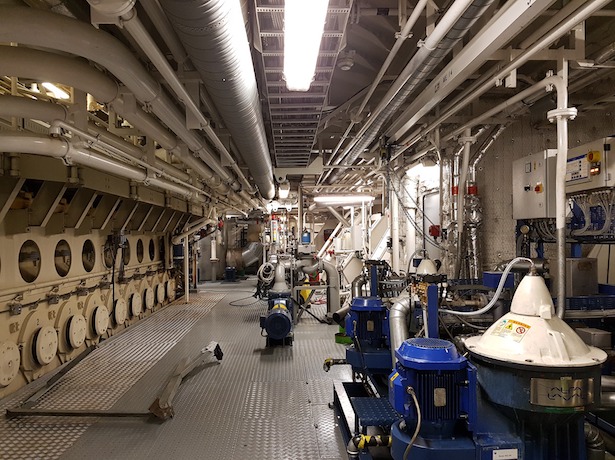
Ship Engine
At Link Ship Chandlers, we love going behind the scenes to find out more about the inner workings of the impressive ships we supply in the course of providing chandling services from South African ports. In this blog and the two to follow we will be looking at the cruise ship engine from a few different angles. We’ll start by discussing the engine room and defining a few important terms.
Read More
Cruise Ship Hygiene Management: Part II
Posted by Link Ship Chandlers under Maritime Facts and Stories, Ship Chandling

The Ins-And-Outs Of Cruise Ship Hygiene – Part II
In a previous blog, we took a look at some of the hygiene processes followed aboard the mega-ships that tour our oceans. Today we’ll be taking a look at the legislation behind it all. The following content is based on the Guide to Ship Sanitation by the NCBI (National Center for Biotechnology Information), which forms a part of the United States National Library of Medicine, a branch of the National Institutes of Health.
Read More


