
South Africa’s Ship Repair Revival Is Gathering Momentum
South Africa’s Ship Repair Revival Is Gathering Momentum
Good News, Mzansi! South Africa’s Ship Repair Revival Is Gathering Momentum
Thousands of commercial vessels travel around Southern Africa each year, connecting Atlantic and Indian Ocean trade. The greater opportunity for the country is not simply to have this traffic pass its coastline, but to give more vessels a reason to stop, spend and obtain maritime services here.
Recent instability affecting traditional shipping routes has sent more vessels around the Cape, sharpening the focus on South Africa’s strategic position [Freight News: Cape has potential to become bunkering hub]. Yet geography alone does not secure a port call. Vessels need reliable, commercially valuable reasons to enter port.
As demand grows for ship repair, South Africa has an opportunity to provide one of those reasons. Stronger repair capacity could attract valuable port calls while supporting a much wider network of maritime suppliers and service providers.
Ship Repair Demand Is Already Growing in Cape Town
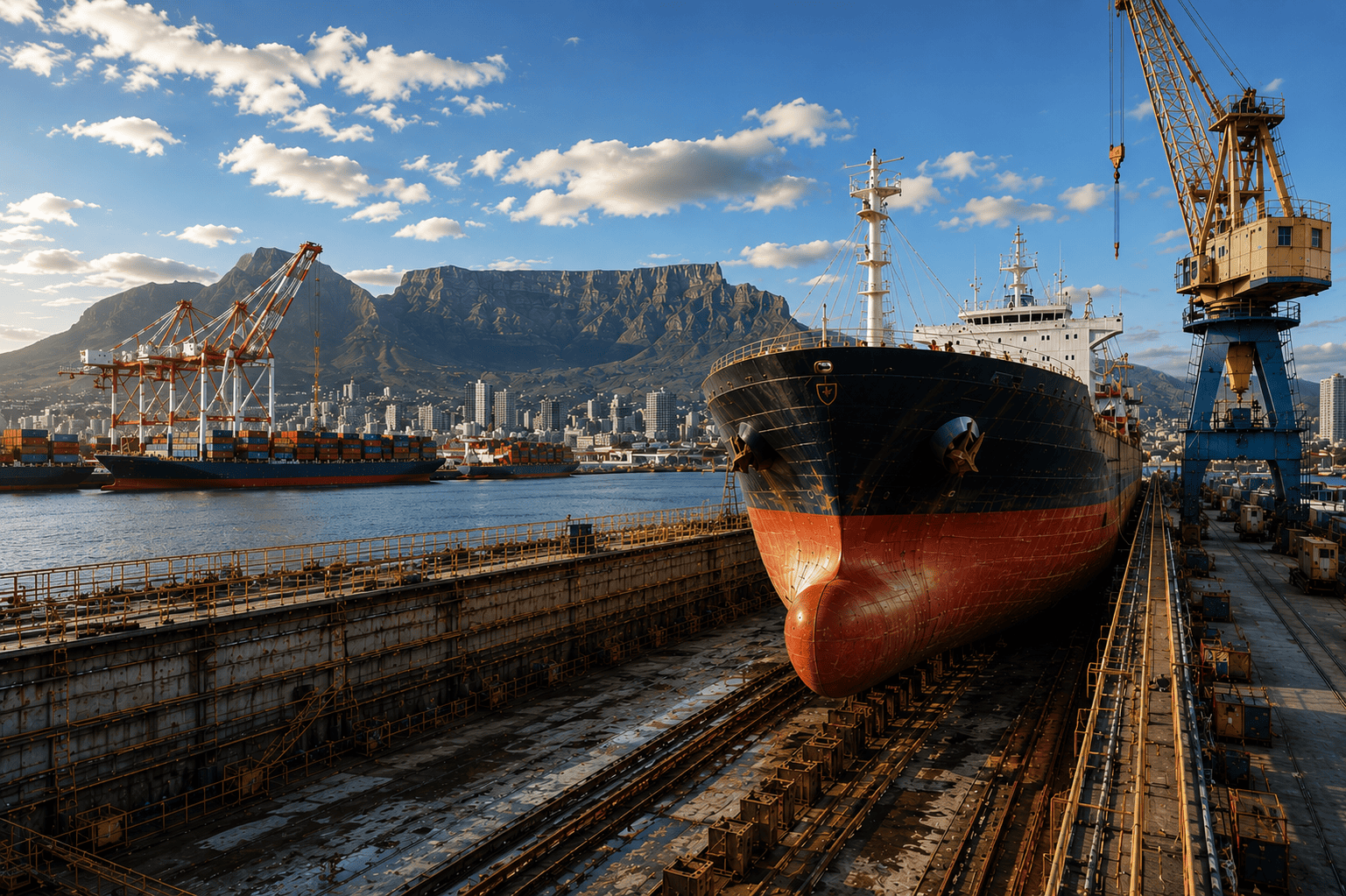
Cape Town’s repair sector is not relying on future potential alone. Two vessels originally scheduled for dry-docking in the Gulf have been redirected to the Cape, while existing and forthcoming work includes chemical tankers, LPG carriers and offshore supply vessels. Bookings at some facilities reportedly extend into 2027 and even 2028, demonstrating growing confidence in the ship repair Cape Town is able to offer.
TNPA’s performance figures reinforce this picture. Cape Town’s repair-facility occupancy has risen from below 50% five years ago to approximately 70%–75%. That places utilisation closer to the roughly 80% occupancy TNPA regards as international best practice, although there is still room for improvement.
During the previous financial year, TNPA serviced 190 vessels against a target of 185, while gross tonnage was 24% above budget. As acting port manager Ophelia Shabane explained, “The ship repair sector is being re-examined as we realise it is a good driver of economic growth.”
Together, these figures suggest that South African ship repair is already gaining commercial traction.
Why Cape Town Wants More Repair Capacity
Higher utilisation also creates pressure. To accommodate growing demand, TNPA is preparing a request for proposals for a private-sector partner to build and operate an additional floating dock in Cape Town. This remains a proposed development, not infrastructure already under construction or in service.
A floating dock can be submerged sufficiently for a vessel to enter, then raised to expose its hull for inspection, maintenance and repair. If delivered, the facility could relieve pressure on existing assets and help prevent valuable repair work from moving to competing ports in neighbouring countries.
Cape Town already supports a varied repair ecosystem. Sturrock Dry Dock accommodates large commercial and specialist vessels, while Robinson Dry Dock and the synchrolift are particularly important to the fishing industry. More than 60% of South Africa’s fish catch passes through the port, demonstrating how closely repair infrastructure can be connected to other maritime industries.
The proposed addition to the Cape Town dry dock network should therefore be understood as a response to established activity. It would expand an existing service base that already supports fishing vessels, offshore operations, rigs and diamond-mining vessels.
READ NEXT: Big, Exciting Changes Coming To Cape Town Harbour!
Bigger Ships Expose A Different Capacity Constraint
Adding capacity is only part of the challenge. According to shipping expert Brian Ingpen, Sturrock Dry Dock’s principal constraint is not its length, but its width. Although it can accommodate smaller vessels comfortably, commercial ships have grown considerably, with some now reaching approximately 400 metres.
This creates a gap between the volume of traffic passing South Africa and the repair work Cape Town can realistically pursue. Ingpen highlighted one company that sends more than 40 bulk carriers to Brazil to load iron ore. Some are comparable in length to four rugby fields and regularly pass the Cape, yet, as he put it, “They are not even considering us for ship repair.”
That example captures the opportunity and the constraint. Proximity to a busy shipping route gives Cape Town access to a substantial potential market, but vessels must also fit the available facilities. Competing for larger ships will require investment shaped around the dimensions of the modern fleet, not only higher utilisation of existing docks.
Repair Capacity Depends On More Than The Dock
A functioning dry dock cannot operate efficiently without the equipment around it. TNPA’s long-planned replacement of ten shore-side cranes for Cape Town’s repair facilities has now reached the evaluation stage. The previous cranes had deteriorated to the point that they were written off.
The operational difference is substantial. Without suitable lifting equipment, preparing dry-dock blocks for an incoming vessel can take four to five days. With the correct cranes available, the same work may be completed in a matter of hours. Faster preparation allows vessels to enter, receive the required maintenance and vacate the dock sooner.
As Ophelia Shabane explained, “It reduces the time it takes to dock and service a vessel.”
Other renewal projects include new caisson gates for the Sturrock and Robinson dry docks, new capstans and further infrastructure upgrades. Collectively, these details show why repair capacity is about more than dock space. Reliable utilities, lifting equipment, skilled personnel, efficient access, specialist contractors and the wider network of vessel services South Africa can provide all influence the quality and speed of a repair call.
ALSO SEE: How 58-Hour Ship Calls Are Reshaping South Africa’s Marine Supply Chain
Durban Is Showing Signs of Renewed Capability Too
Cape Town is not the only port showing renewed repair activity. In July 2026, the 228-metre Marshall Islands-flagged crude oil tanker Troy entered Durban’s Prince Edward Graving Dock. It was the first commercial vessel of its size to use the historic facility in more than a decade and ranked among the longest vessels ever accommodated there.
The tanker spent ten days undergoing maintenance, repairs and mandatory statutory inspections. Its arrival followed TNPA’s R200 million modernisation programme, which included installing seven new capstans to improve productivity and operational efficiency.
As Durban Port Manager Mpumi Dweba-Kwetana observed, “Every vessel entering Prince Edward Graving Dock is more than a maintenance project.”
This milestone provides a tangible sign of the ship repair Durban can accommodate following recent investment. It does not prove that the sector has fully recovered, but it demonstrates that the Durban dry dock can again support large, technically complex vessels while creating opportunities across the local repair value chain.
Geography Creates An Opportunity, Not A Guarantee
South Africa’s position between Atlantic and Indian Ocean trade routes places it close to a substantial potential market. Recent instability affecting the Suez Canal and Strait of Hormuz has encouraged more operators to route vessels around the Cape. However, increased passing traffic does not automatically produce more South African port calls.
Repair, maintenance and bunkering can provide practical reasons to stop, but operators will also consider service reliability, infrastructure and turnaround times. Cape Town’s constraints illustrate how these elements interact. With some container ships now reaching approximately 330 metres, only three can be accommodated along the relevant quay at one time. Equipment, terminal layout and port efficiency can therefore influence the appeal of the wider service destination.
The strategic question is not simply how many vessels pass South Africa. It is how many can be given a commercially persuasive reason to call. Strong repair capability, supported by the broader range of marine services South Africa can provide, could help convert geographic potential into more valuable port activity.
LEARN MORE: The Green Shipping Revolution Is Coming To Africa: What Ship Owners Need To Know
One Repair Project Reaches Far Beyond The Dry Dock
The commercial value of a repair call extends well beyond the amount invoiced by the yard. A large vessel can mobilise marine engineers, welders, fabricators, electricians, divers and coating specialists, alongside equipment suppliers, logistics providers, ship agents and chandlers.
The scale can be considerable. According to TNPA, more than 3,000 people may be employed across vessel-repair projects at any given time. Shipping expert Brian Ingpen has also noted that a single rig project can inject several million dollars into the surrounding economy. These projects can create work ranging from general labour to highly specialised technical services.
Durban’s recent Troy maintenance project reflects the same multiplier effect. TNPA identified opportunities for contractors, equipment suppliers, logistics providers and other businesses across the local repair value chain.
A repair yard may be the centre of the project, but it does not operate in isolation. Each vessel depends on a network of people and businesses capable of keeping the work, crew and procurement process moving. This is why stronger repair activity can benefit the wider maritime economy.
Where Ship Chandlers Fit Into A Repair Call
A vessel undergoing maintenance remains both a working environment and a temporary home for its crew. Provisions must be replenished, cleaning and maintenance work continues, and technical teams may identify additional requirements once inspections are underway. Longer or more complex port stays can therefore create demand for food, toiletries, deck stores, PPE, cleaning products and maintenance consumables.
This is where experienced ship chandlers in South Africa can support the repair ecosystem. By coordinating procurement and delivering required goods to the vessel, chandlers help owners, agents and vessel managers keep the port call moving.
Link Ship Chandlers supports vessels calling at Cape Town and Saldanha on the west coast, as well as Port Elizabeth, Coega and East London along the Eastern Cape coastline. Its Durban and Richards Bay branches extend that supply network into KwaZulu-Natal.
This footprint allows us to provide ship supplies that South African vessel operators may require across several key calling points. It also demonstrates why chandling forms part of the wider service infrastructure surrounding a competitive repair destination.
ALSO SEE: Ship Chandlers = Secret Weapon In The Maritime Industry (Here’s Why!)
From Ports To Maritime-Service Hubs
Efficient cargo handling remains fundamental, but it is only one way ports create value. A competitive maritime destination can bring together cargo operations, repairs, bunkering, provisioning, technical support, logistics and crew services.
Each additional capability gives vessels another practical reason to call and increases the potential value of their stay. The current demand in Cape Town, investment in supporting equipment and renewed capability demonstrated in Durban suggest growing momentum, rather than a completed national transformation.
The larger opportunity is for South African ports to become service destinations in their own right. By developing dependable maritime ecosystems around traffic already passing the coastline, the country can capture more economic value from its strategic position.
Building More Valuable Vessel Calls
South Africa’s ship-repair revival will depend on sustained investment, reliable infrastructure and consistent service delivery. Its potential impact, however, reaches far beyond the dry dock.
Whether a vessel calls to load cargo, undergo maintenance or replenish supplies, dependable procurement and provisioning remain essential. Calling at a South African port? Contact Link Ship Chandlers for reliable vessel provisioning and ship supplies.


Leave a Reply